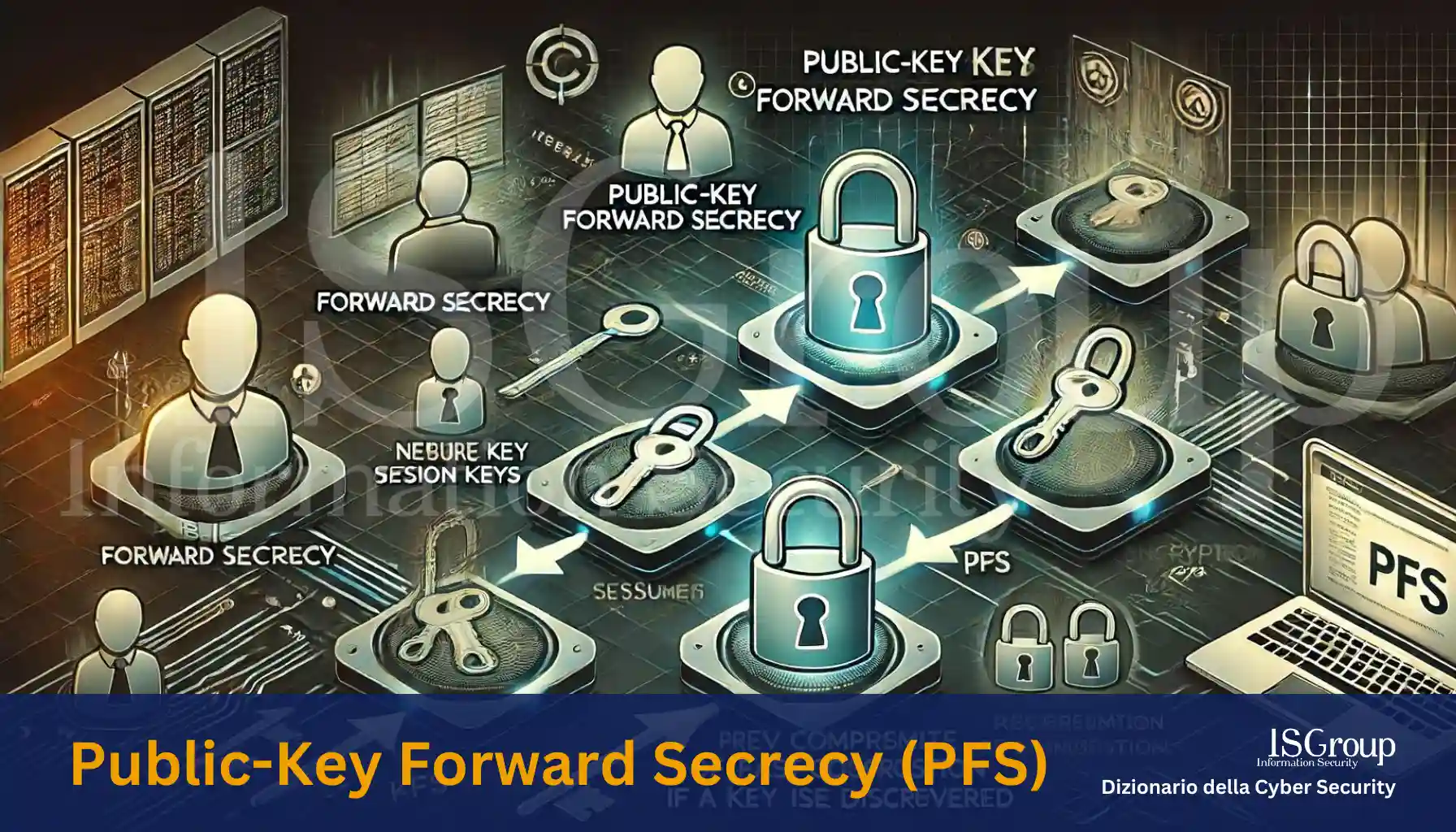
Public-Key Forward Secrecy (PFS) is a security property in key agreement protocols based on asymmetric cryptography. This property ensures that a session key derived from a set of long-term public and private keys will not be compromised if one of the private keys is compromised in the future.
Detailed Description:
In cryptography, the importance of Forward Secrecy (FS) lies in protecting data transmitted in the past, even if one of the long-term private keys is compromised. PFS applies this concept to public-key cryptography.
Imagine an encrypted conversation between two parties, Alice and Bob. They use a key agreement protocol to establish a session key that will be used to encrypt their messages during a specific session. If this protocol supports PFS, even if an attacker manages to obtain one of Alice’s or Bob’s private keys in the future, they would not be able to decrypt past conversations because the session keys used for each session are independent of the compromised long-term keys.
How it Works:
- Key Agreement: During the start of communication, Alice and Bob use their long-term public and private keys to exchange information securely.
- Session Key Generation: A temporary session key is generated, derived from the long-term keys and a secure negotiation process. This session key will be used to encrypt the messages exchanged during that particular session.
- Session Isolation: Each session uses a different session key. This isolation ensures that even if a long-term private key is compromised in the future, previous session keys cannot be reconstructed by the attacker.
Benefits of PFS:
- Protection of Historical Data: Data transmitted in past sessions remains protected even if long-term private keys are compromised.
- Risk Reduction: It limits the impact of a long-term key compromise, making long-term communication more secure.
- Continuous Confidentiality: It maintains the confidentiality of past communications even in the event of future attacks.
Examples of Use:
- Internet Security Protocols: TLS (Transport Layer Security) and HTTPS often implement PFS to protect web communications.
- Messaging Applications: Secure messaging services, such as Signal and WhatsApp, use PFS to ensure that previous messages remain private even if long-term keys are compromised.
Conclusion:
Public-Key Forward Secrecy is a crucial feature for ensuring the long-term security of encrypted communications. By implementing PFS, organizations can better protect their data and communications, ensuring that information transmitted in the past remains secure even in the event of a private key compromise in the future.
Want to give your company the highest level of cyber security? ISGroup SRL is here to help with cyber security solutions tailored to your business.
Would you like us to take care of everything for you? Our Virtual CISO and vulnerability management services are a perfect fit for your organization.
Already know what you need? Explore our services:
- Vulnerability Assessment
- Network Penetration Testing
- Web Application Penetration Testing
- Mobile Application Security Testing
- Ethical Hacking
- Training
And much more. Protect your company with the best cybersecurity experts!