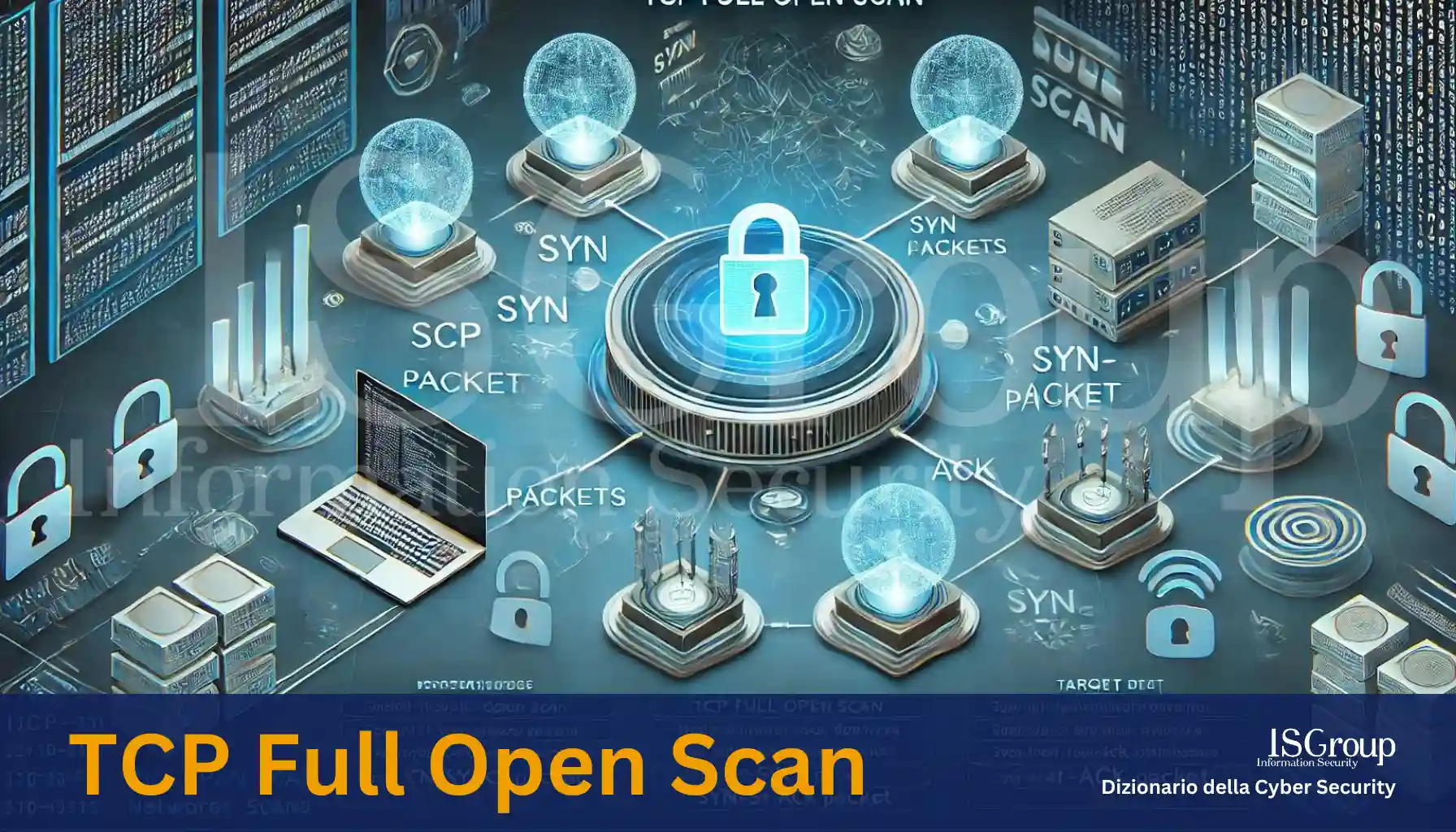
The TCP Full Open Scan, also known as “TCP Connect Scan,” is a technique used to scan the ports of a computer system to verify their status. This technique relies on completing the three-way handshake of the TCP (Transmission Control Protocol) to determine if a port is open.
How it works: The process of a TCP Full Open Scan can be described in the following steps:
- Connection Initiation (SYN): The client (the attacker or the scanner) sends a SYN (synchronize) packet to the server port intended for testing.
- Server Response (SYN-ACK): If the port is open, the server will respond with a SYN-ACK (synchronize-acknowledge) packet.
- Client Confirmation (ACK): The client responds with an ACK (acknowledge) packet, thus completing the “three-way handshake.” This confirms that the port is open and listening for connections.
If the port is closed, the server will respond with an RST (reset) packet, indicating that the connection cannot be established.
Advantages:
- Reliability: Because the TCP Full Open Scan performs the entire three-way handshake, it is very reliable in determining the status of ports.
- Compatibility: This technique works on any system that implements the TCP protocol, making it universal and widely applicable.
Disadvantages:
- Detectability: Completing the three-way handshake makes this technique easily detectable by Intrusion Detection Systems (IDS), as it generates a full connection that can be logged and analyzed.
- Time and Resources: Performing a full handshake on many ports can take more time and resources compared to other faster and less intrusive scanning techniques, such as the TCP SYN Scan.
Common Uses: The TCP Full Open Scan is commonly used in cybersecurity for:
- Security Assessments: Identifying open ports on a system as part of a vulnerability assessment.
- Penetration Testing: Used by penetration testers to determine which services are active on a target system.
- Research and Development: Analysis and study of port behavior across different network configurations and operating systems.
Ethical and Legal Considerations: Performing port scans without authorization is considered an intrusive activity and may be illegal. It is essential to always obtain the appropriate permission before performing any type of port scan on networks or systems that do not belong to you.
In conclusion, the TCP Full Open Scan is a powerful and reliable technique for port scanning, offering precise results at the cost of higher detectability and resource consumption. Used responsibly, it can provide crucial information for the security of networks and computer systems.
Want to give your company the highest level of cyber security? ISGroup SRL is here to help with cyber security solutions tailored to your business.
Would you like us to take care of everything for you? Our Virtual CISO and vulnerability management services are a perfect fit for your organization.
Already know what you need? Explore our services:
- Vulnerability Assessment
- Network Penetration Testing
- Web Application Penetration Testing
- Mobile Application Security Testing
- Ethical Hacking
- Training
And much more. Protect your company with the best cybersecurity experts!