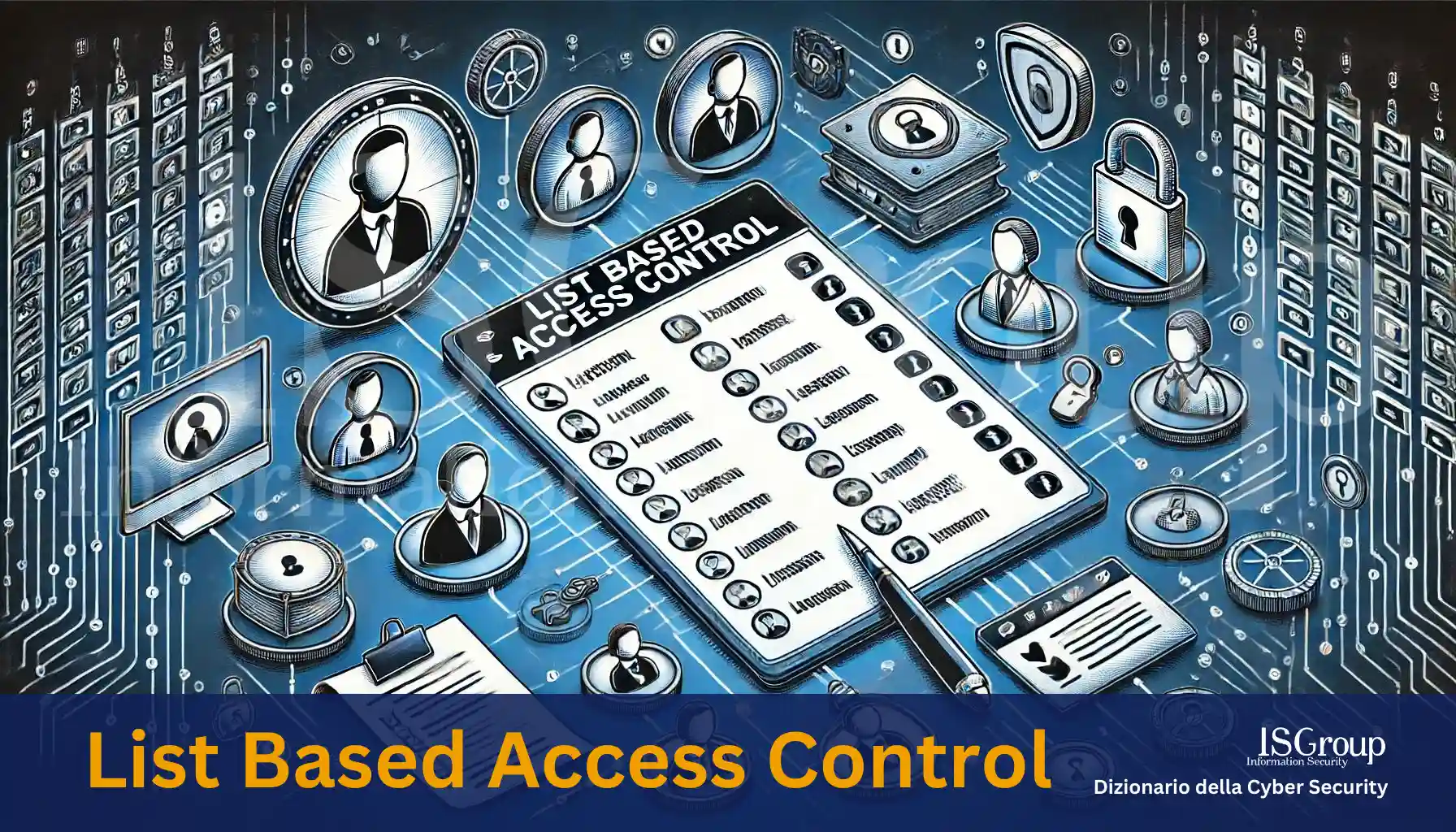
“List Based Access Control” (LBAC) is an access control model that associates a list of users and their privileges with each object. This approach is based on the idea of having an Access Control List (ACL) for every resource, such as files, directories, or any other protected object, in which authorized users and their relative permissions are specified.
Main Features
- Access Control List (ACL): Each object has its own ACL that specifies which users can access the object and what operations they can perform. Typical operations include read, write, execute, and delete.
- Centralized Privilege Management: System administrators can easily manage and update ACLs by adding or removing users and modifying their privileges. This makes permission management simpler and more centralized.
- Granularity of Permissions: LBAC allows for specifying detailed permissions for each user on each object. This enables fine-grained control over the operations each user can perform, improving security.
- Transparency for Users: Users do not need to worry about permission management, as these are defined and managed by administrators. Users only see what is permitted by the ACLs associated with the objects.
Advantages
- Enhanced Security: Since permissions are specific to each user and object, it is possible to configure the system very securely, allowing only the necessary operations.
- Flexibility: It is possible to quickly adapt permissions in response to changes in operational needs or user roles.
- Audit and Monitoring: ACLs make it easy to track and monitor who has access to what, facilitating audit activities and the detection of unauthorized access.
Disadvantages
- Complex Management: In environments with many users and objects, managing ACLs can become complex and time-consuming.
- Scalability: For large organizations, maintaining ACLs can become burdensome, especially if permissions change frequently.
Practical Example
Imagine a document management system in a company. Each document could have an ACL that specifies which users can view, edit, or delete the document. For example:
- Document: “Annual Report”
- User: Mario Rossi – Permissions: Read, Write
- User: Anna Bianchi – Permissions: Read
- User: Luca Verdi – Permissions: None
In this scenario, Mario Rossi can read and edit the annual report, Anna Bianchi can only read it, while Luca Verdi has no access to the document.
Conclusion
List Based Access Control is an effective approach for managing access permissions in computer systems, especially when granular and centralized privilege management is required. However, it requires careful administration to maintain security and operational efficiency, especially in large-scale contexts.
Want to give your company the highest level of cyber security? ISGroup SRL is here to help with cyber security solutions tailored to your business.
Would you like us to take care of everything for you? Our Virtual CISO and vulnerability management services are a perfect fit for your organization.
Already know what you need? Explore our services:
- Vulnerability Assessment
- Network Penetration Testing
- Web Application Penetration Testing
- Mobile Application Security Testing
- Ethical Hacking
- Training
And much more. Protect your company with the best cybersecurity experts!