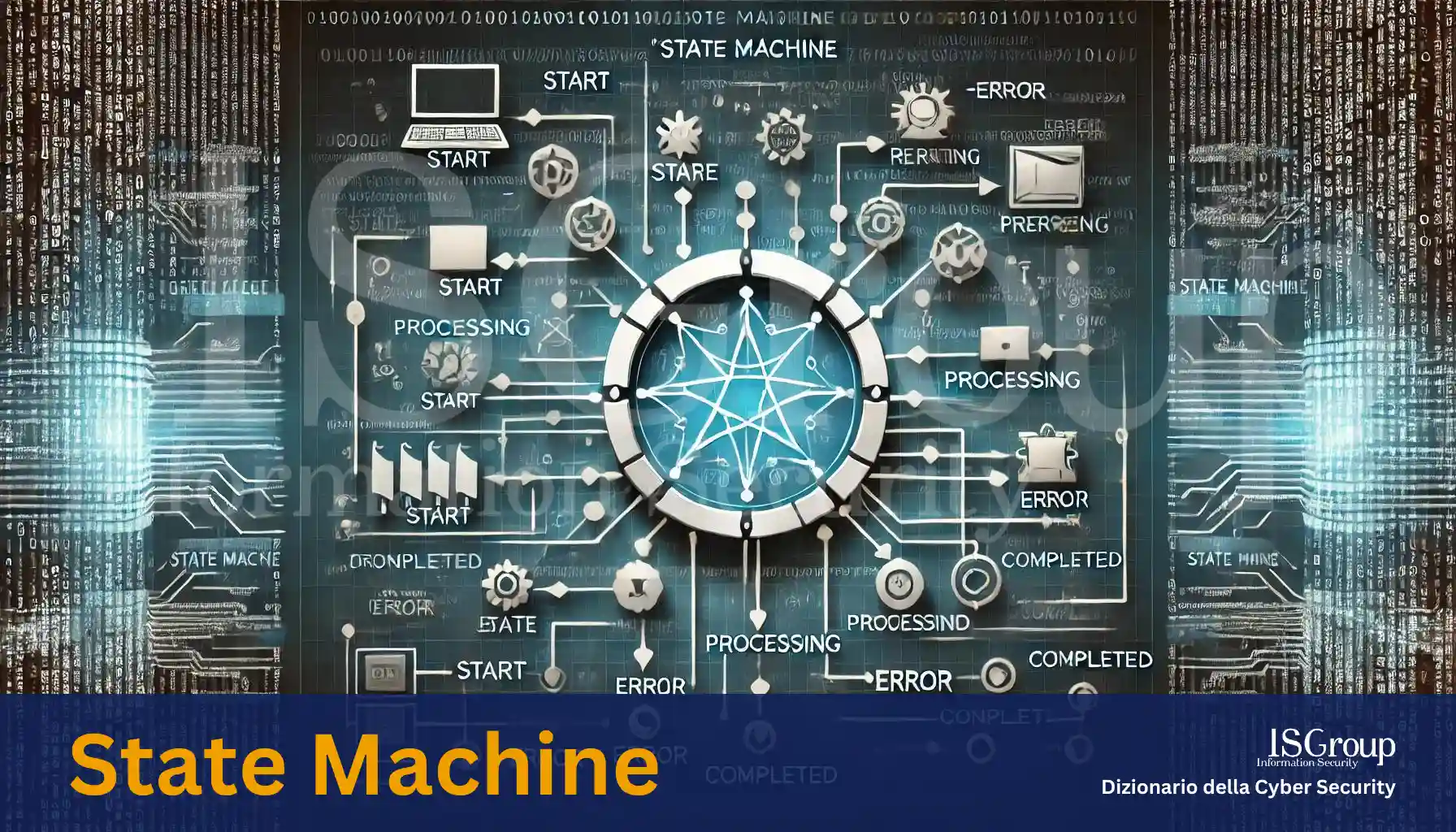
A state machine is a system that moves through a series of progressive conditions. This structure is used in many fields of computer science, electronics, and automation to model the behavior of complex systems.
Main Components
- States: Represent the different conditions or situations in which the system can exist. Each state is a unique configuration of variables and conditions.
- Transitions: These are the actions or events that cause the passage from one state to another. Transitions can be triggered by external events, internal system conditions, or a combination of both.
- Events: These are the triggers that initiate transitions. They can be user inputs, state changes in other systems, or time-based events.
- Actions: These are operations performed during a transition or when a particular state is active. Actions can include activating other systems, modifying internal variables, or sending signals.
Types of State Machines
- Finite State Machine (FSM): This type of machine has a limited and well-defined number of states. It is often used for simple systems where the number of states is contained.
- Extended Finite State Machine (EFSM): An extension of the FSM that includes variables and conditions in the transitions, allowing for greater complexity and flexibility in behavior.
- Hierarchical State Machine (HSM): This type of state machine allows for the definition of states within other states, creating a hierarchical structure that can simplify the management of complex systems.
Applications
State machines are used in a wide range of applications, including:
- Industrial Automation: Control of production processes, management of assembly lines, and robot control.
- Computer Science: Language parsing, memory management, communication protocols.
- Electronics: Digital circuit design, control of electronic devices.
- Video Games: Modeling the behavior of non-player characters (NPCs), managing game levels.
Example
Let’s imagine a state machine for a traffic light:
- States: Red, Green, Yellow.
- Transitions: Transition from Red to Green, from Green to Yellow, and from Yellow to Red.
- Events: Timer that determines the duration of each state.
- Actions: Changing the color of the traffic light, updating timers.
Conclusion
State machines are powerful tools for modeling and managing the behavior of complex systems. Understanding and implementing a state machine can significantly simplify the design and control of many systems, making them more predictable and manageable.
Want to give your company the highest level of cyber security? ISGroup SRL is here to help with cyber security solutions tailored to your business.
Would you like us to take care of everything for you? Our Virtual CISO and vulnerability management services are a perfect fit for your organization.
Already know what you need? Explore our services:
- Vulnerability Assessment
- Network Penetration Testing
- Web Application Penetration Testing
- Mobile Application Security Testing
- Ethical Hacking
- Training
And much more. Protect your company with the best cybersecurity experts!