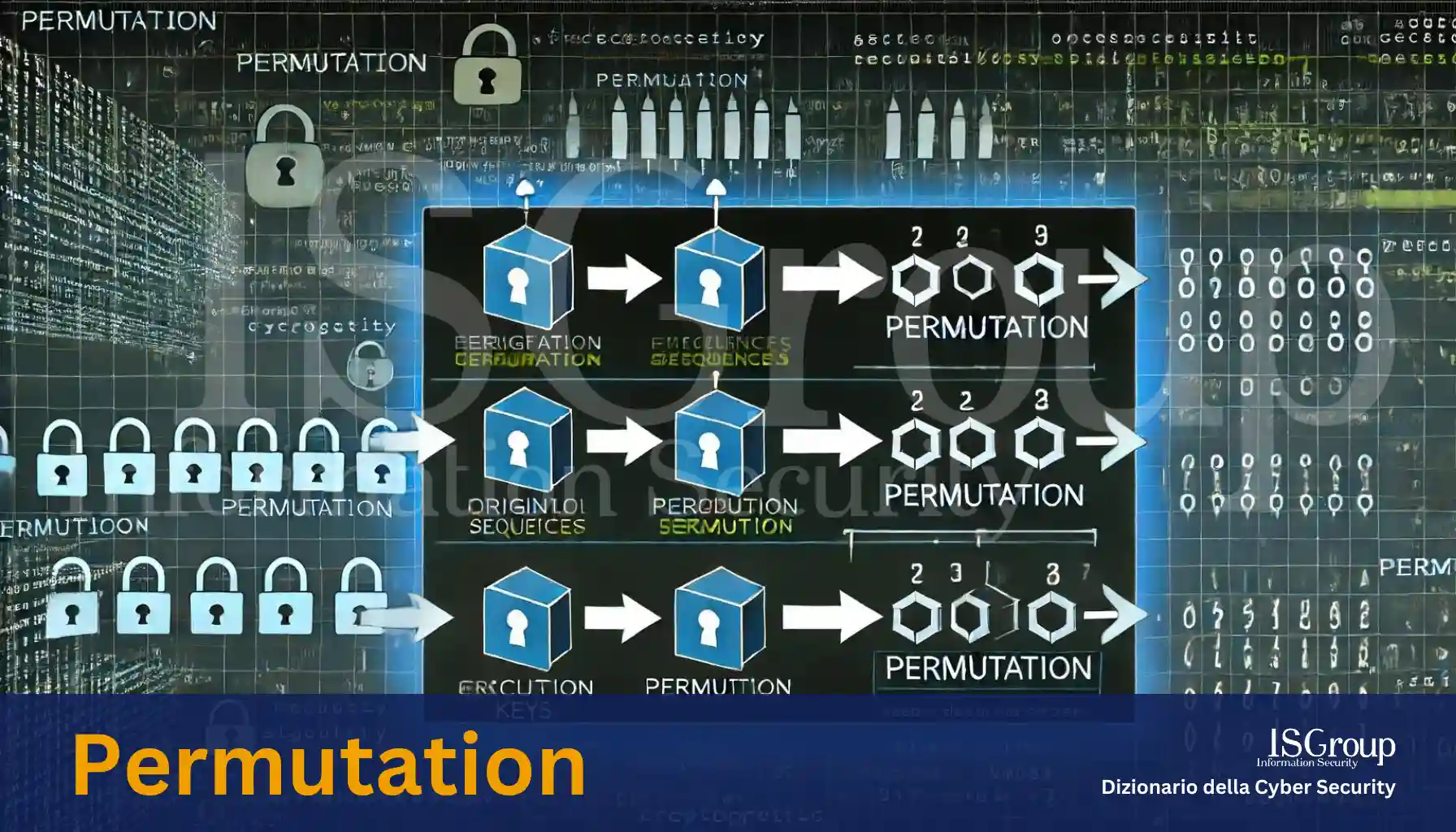
Permutation is a mathematical and combinatorial concept that refers to the act of rearranging a series of elements into a different order. In its simplest form, a permutation keeps the same elements but changes their position within a text or sequence, thus creating a new arrangement of the same components.
Definition and Usage
In cryptography, permutation is often used to confuse a message, making it difficult to read or interpret without a specific key. For example, by taking a word or a phrase and changing the order of the letters, one can obtain seemingly nonsensical text that can only be deciphered by knowing the original sequence and the permutation algorithm used.
Practical Example
Let’s consider the word “GATTO” (Italian for “cat”). The possible permutations of this word include:
- GATTO
- GOTTA
- AGTTO
- ATGTO
- TOGAT
- and so on.
Each of these words is a permutation of the original, maintaining the same letters but in a different order.
Importance in Cryptography
In the field of cryptography, permutation is a fundamental technique. Often combined with other operations such as substitution, it allows for the creation of complex ciphers. A historical example is the transposition cipher, where the letters of the plaintext are permuted according to a predefined rule.
Mathematics of Permutation
Mathematically, a permutation of a set of n elements is one of the n! (n factorial) possible orderings of those elements. For example, for a sequence of three elements {A, B, C}, there are 3! = 6 possible permutations:
- ABC
- ACB
- BAC
- BCA
- CAB
- CBA
Applications in Computer Science
In computer science, permutation algorithms are used in various fields, from generating combinations to test systems to solving optimization problems. Permutations also play a crucial role in data analysis and simulations, where various scenarios and configurations must be explored systematically.
Conclusion
In summary, permutation is a powerful mathematical and cryptographic tool that, through the reorganization of the elements of a set, allows for the creation of new arrangements and, in the context of cryptography, the protection of information. Its importance extends well beyond theory, finding practical applications in many sectors of science and technology.
Want to give your company the highest level of cyber security? ISGroup SRL is here to help with cyber security solutions tailored to your business.
Would you like us to take care of everything for you? Our Virtual CISO and vulnerability management services are a perfect fit for your organization.
Already know what you need? Explore our services:
- Vulnerability Assessment
- Network Penetration Testing
- Web Application Penetration Testing
- Mobile Application Security Testing
- Ethical Hacking
- Training
And much more. Protect your company with the best cybersecurity experts!