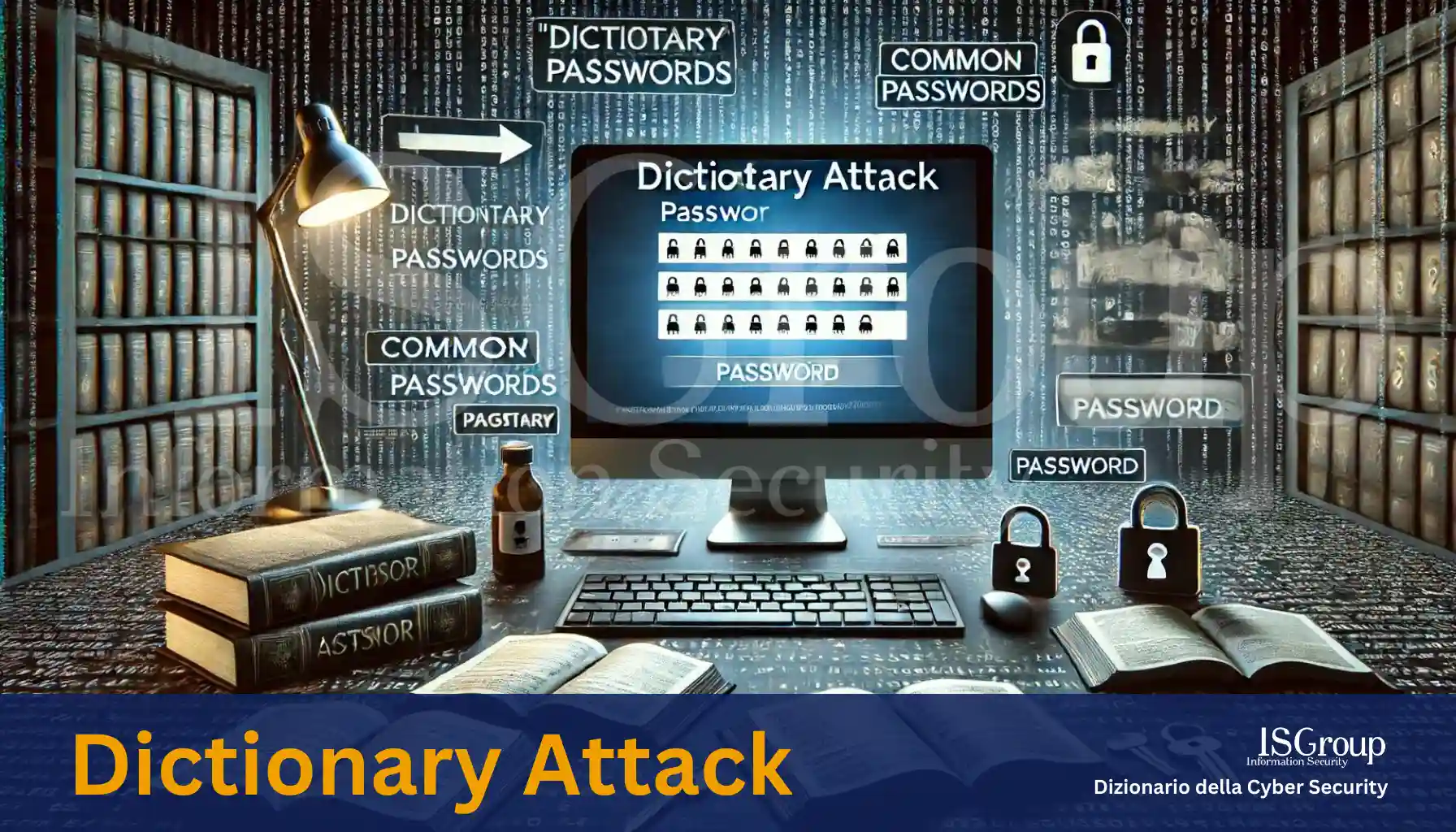
A dictionary attack is a technique used by cybercriminals to attempt to breach passwords or access keys. This attack methodology exploits a predefined list of words, usually contained in a text file called a “dictionary.” Unlike a brute-force attack, which tries every possible combination of characters, a dictionary attack relies on real words and common phrases, often making it faster and more efficient.
How It Works
The operation of a dictionary attack is relatively simple:
- Dictionary Preparation: Attackers create or obtain a dictionary file containing a list of common words and phrases. These dictionaries can be specific to a language or cultural context, including words frequently used as passwords.
- Access Attempts: Using specific software, the attacker attempts to access a system by trying one word at a time from the dictionary list. Each word is entered as a potential password until the correct one is found.
- Results: If one of the words in the dictionary matches the actual password, the attacker gains access to the target system.
Advantages and Disadvantages
Advantages:
- Speed: Because it is based on common words, a dictionary attack can be faster than a brute-force attack.
- Efficiency: By using words that people tend to choose as passwords, it has a higher probability of success, especially if the passwords are not complex.
Disadvantages:
- Limited to Common Words: If the password is complex and not present in the dictionary, the attack will fail.
- Strong Hashing Protection: Systems that use strong and unique hashing algorithms can render a dictionary attack ineffective.
Protection against Dictionary Attacks
To protect yourself from a dictionary attack, it is essential to adopt some best practices in password management:
- Complex Passwords: Use long and complex passwords that include uppercase and lowercase letters, numbers, and special characters.
- Password Management Software: Use a password manager to generate and store unique and complex passwords for every service.
- Implementation of Hashing Algorithms: Ensure that systems use strong hashing algorithms and unique salts for each user.
In conclusion, a dictionary attack represents a significant threat, but with the right precautions, it is possible to mitigate the associated risks. Adopting robust passwords and leveraging advanced security technologies can make all the difference in protecting your sensitive data.
Want to give your company the highest level of cyber security? ISGroup SRL is here to help with cyber security solutions tailored to your business.
Would you like us to take care of everything for you? Our Virtual CISO and vulnerability management services are a perfect fit for your organization.
Already know what you need? Explore our services:
- Vulnerability Assessment
- Network Penetration Testing
- Web Application Penetration Testing
- Mobile Application Security Testing
- Ethical Hacking
- Training
And much more. Protect your company with the best cybersecurity experts!