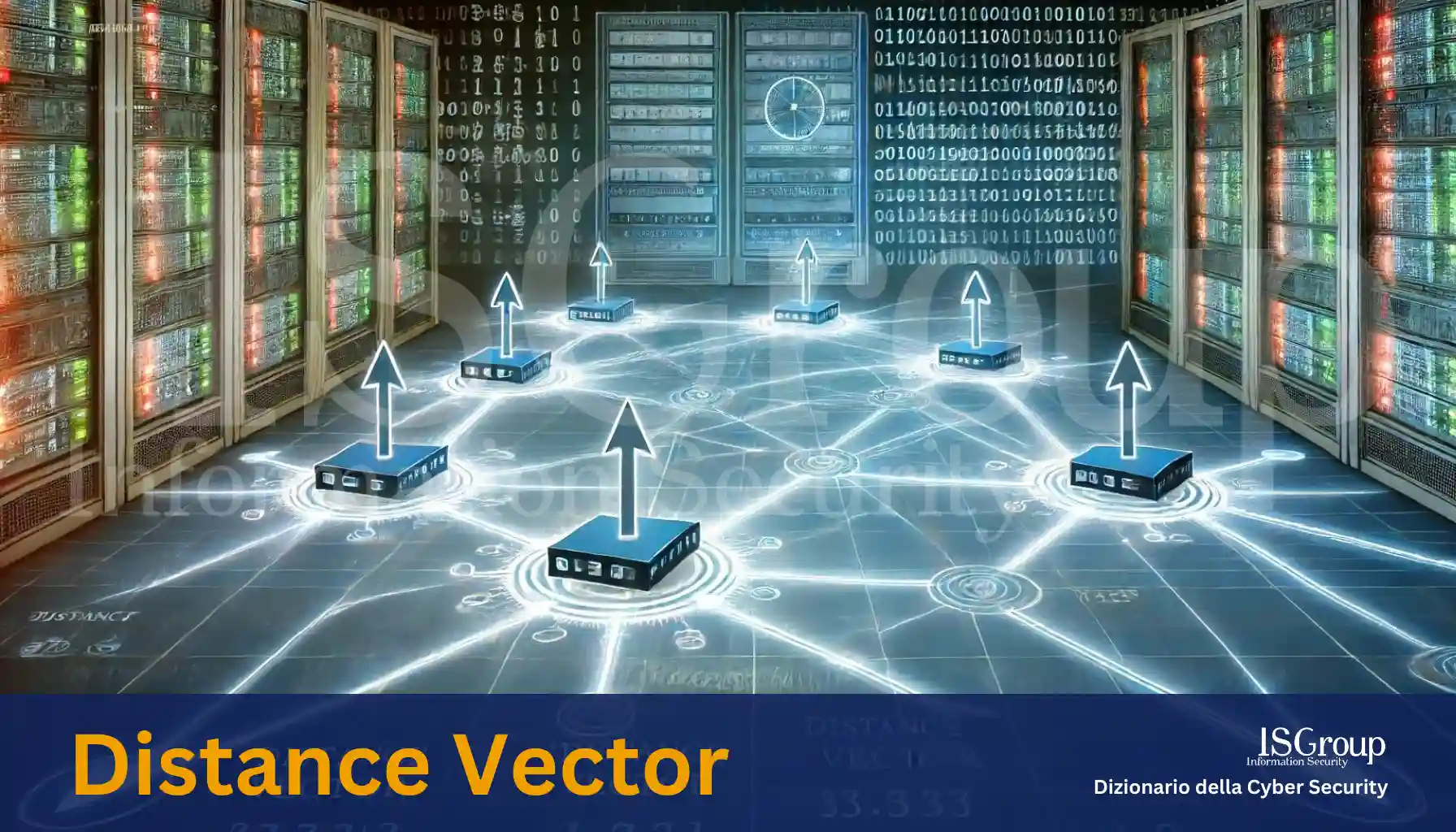
Distance Vector is a fundamental concept in telecommunications networks and routing protocols. It measures the cost of routes to determine the best path to reach all known networks. This routing method is used to establish how data packets should be forwarded across a computer network, ensuring they reach their destination efficiently and reliably.
How Distance Vector Works
The operating mechanism of Distance Vector is based on the use of routing tables that each router maintains and updates periodically. These tables contain information about available routes and the “cost” associated with each route. The cost can be defined in terms of metrics such as hop count, delay time, bandwidth, or other parameters relevant to the specific network.
- Periodic Updates: Each router periodically sends copies of its routing tables to neighboring routers. These updates contain information about the distances (in terms of cost) to reach every known network.
- Route Calculation: When a router receives an updated routing table from a neighbor, it compares the received information with its own. If it finds a route with a lower cost through the neighbor, it updates its own routing table to reflect this new, more efficient route.
- Convergence: Through repeated exchanges of routing tables, the routers in the network converge on a set of optimal routes. Convergence occurs when all routers have a consistent view of the best available routes.
Advantages and Disadvantages
Distance Vector has several advantages:
- Simplicity: It is relatively simple to implement and understand.
- Efficiency for Small Networks: It works well in small-scale networks where the topology does not change frequently.
However, it also presents some disadvantages:
- Slow Convergence: In large networks, convergence can take a long time, especially in the presence of frequent topological changes.
- Count to Infinity: A known problem where routing updates can cause infinite loops of cost increments (for example, when a route becomes unreachable).
- Scalability Limitations: It is not suitable for very large or complex networks due to the volume of update traffic and the slowness in responding to changes.
Distance Vector-Based Protocols
Some of the most well-known routing protocols that use Distance Vector are:
- RIP (Routing Information Protocol): One of the oldest and simplest routing protocols; it uses hop count as a metric to determine route costs.
- IGRP (Interior Gateway Routing Protocol): Developed by Cisco, it uses multiple metrics to calculate route costs, offering greater flexibility compared to RIP.
Conclusion
Distance Vector is a fundamental routing technique that has had a significant impact on the development of telecommunications networks. Despite its limitations, it continues to be a valid choice in specific contexts due to its simplicity and ease of implementation. Understanding how Distance Vector works is essential for anyone working in the field of networking and data traffic management.
Want to give your company the highest level of cyber security? ISGroup SRL is here to help with cyber security solutions tailored to your business.
Would you like us to take care of everything for you? Our Virtual CISO and vulnerability management services are a perfect fit for your organization.
Already know what you need? Explore our services:
- Vulnerability Assessment
- Network Penetration Testing
- Web Application Penetration Testing
- Mobile Application Security Testing
- Ethical Hacking
- Training
And much more. Protect your company with the best cybersecurity experts!